Wednesday, April 29, 2009

33 Weeks Pregnant With Sore Belly And Back?

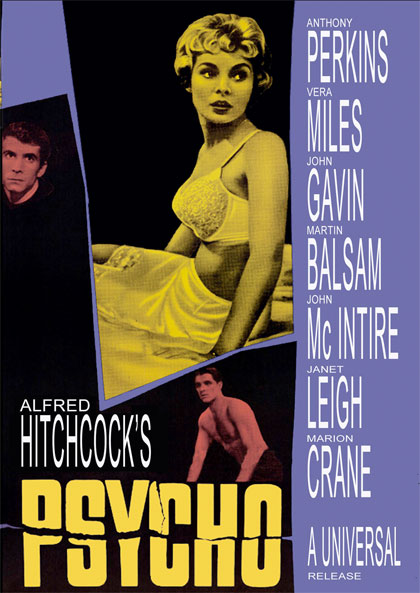
Psycho


Title: Psycho
Director: Alfred Hitchcock
Years: 1960
Genre: Yellow


A nice employee steals forty thousand U.S. dollars and escaped. Change the machine is in the midst of a storm and decide to spend the night in a motel. Norman is the owner, apparently a great guy who shows only some small strangeness, stuff like that of birds. The motel does not host any other customer. The woman decides to take a shower before bed. Under the water is attacked and killed by another woman who just sees. Norman discovers the body in the morning. Horrified does cleaning, put the corpse in the trunk of the car and making it disappear into the quicksand. Upset because he knows that the assassin is his mother, who is pathologically jealous of his son and can not bear even to speak with other women. A private investigator, with the help of the boyfriend of the murdered woman, unable to resolve the tangle, even if we call life. Norman and his mother are the same person: the guy is crazy, after killing his mother out of jealousy he kept the body in the attic and was identified in her unable to bear the guilt of his crime. Psycho was not the best Hitchcock films, but sometimes the ways of the mysterious cult of speed limit. In the sixties, the practice of the unconscious was certainly not new, it was already a sensation in 1944 with Spellbound (Gregory Peck, with the help of Bergman and a "Freudian" analytically solve their troubles going back to a childhood accident), but Anthony Perkins had given an interpretation of that to become effective by that time the most famous " crazy "in the history of cinema, without a real chance to break free from that role. The critics have never forgiven Hitchcock excessive harshness (and effects) of certain scenes. We recall the most famous: the skull of his mother sitting in his swivel chair, the death of a private detective (Martin Balsam ), the left house Bates always framed against a threatening sky. Especially the sequence of the killing of Janet Leigh in the shower has created a true collective psychosis.


Sreaming

Download

Sunday, April 26, 2009

Recover From Anorexia Before And After

of October: Ten Days That Shook the World by Sergej M. Eisenstein


Title: October: Ten Days That Shook the World
Director: Sergei M. Eisenstein
Years
1917 Genre: Drama


1. The sudden recovery, even in Italy, general studies and monographs on Soviet cinema and the directors of the '20s, accompanied by anthologies of theoretical writings and memories and testimonies of the leaders, is certainly a sign positive that bridges, in part, old gaps, pushing to revise the "accommodation" archaic or hasty, proposes, as happened in France, but hopefully with other critical consciousness, a point of reference, historical, theoretical, and the explosion postsessantottesca after reflow "doctrinaire" the debate on the relationship between cinema and revolution.
This is, again, the anthology that do not cover all the dissatisfaction and curiosity for the many texts (Eisenstein, Vertov, the Feks) waiting to be translated and available in reliable editions and philological ordered according to strict historical criteria . While endures, of course, the Italian malaise fueled by poor circulation works and experiences in relation to which the theoretical writings raised in terms of widespread production, rather than as a closed theory in its "specific".
For this, baffles security, often peremptory, which experiences very articulate, contradictory and often conflicting, are, by some of our scholars, the first similar to the common denominator of a generic notion of "cutting edge" and traced, then , in a scheme "theoretical" argument that, from October '17 to Piano, "begins to be implemented progressively, with a stiffness that will not leave any more space, the process of reconstruction of the entire working class, reduced to the role of workforce, productivity in a socialist, and, in parallel, the ideological identification of socialism with developing the work done, the reorganization of productivity ', a process that would, among other things, the effect of promoting' the organic integration of ' vanguard in a society that gradually slips into the all-embracing consolidation and reduction of the identical in all the social plan. "Hence, by deduction really" totalitarian "and ignoring the analysis of individual and often irreducible individual and group contributions, the conclusion that "the vanguard of the revolution put together as self-awareness and self-development 'and' carries in itself, beyond the trial and denial, a particular technology, underground, with productivity, that is integrated to the ideology of the reorganization of work. " So, in an apocalyptic hindsight, "by Mayakovsky to constructivism, the eccentric to the development itself as Eisenstein emergency revolutionary practice of violent transformation that breaks the old Tsarist world-farmer and opens on the future of technology and mass production on planning as a value in itself. "
And, therefore, with more explicit and categorical formulation by others, "the methodological and technical restructuring proposed by Eisenstein and other Russian formalists in the production Art 'is not merely "the answer, smarter and more advanced culture to new demands and new structure required by the political and economic system: Eisenstein and the future - even more than the formalism - are presented as the rational development of ideology and functional Soviet economy and society as a whole '. "' And, hailing passionately involved in the inevitable and recurring target of these executions:" The Cinema of Eisenstein intends to maintain the ambiguity between formal research and revolutionary commitment, objectively However, as a formal research is part of the general ideology of "technological myth" of the years immediately following the NEP, and end up as a particular audience, the vanguard of bourgeois intellectual and "not" bourgeois revolutionary commitment as it is merely the saga of communism, he reconstructs the great moments of its history, now seen as a process already, already made and concluded, that you can only sing the glories: it is only the object of revolutionary cinema of Eisenstein, not its real function '' `. And thus "the commitment of Eisenstein's film runs out to" sing "- a voice that only hearts can feel noble intellectual avant-garde - the past of the revolution, its glorious history, its big business, but do not care for no development of the revolution, its future, its real possibilities of change. "Where disconcerting, in a serious scholar and reliable, along with the peremptory unverifiable judgments, the simultaneous liquidation, in one of three fundamental issues: the location-specific historical and productivity theoretical and practical experience of Eisenstein, the general problem and historically specific dialectic between society groups, intellectuals and revolutionaries in a revolution in progress or not yet fully and finally passed off in the totality of "consolidation" and the "development", function and responsibility in promoting and organizing the party - or not - an active reception, socialized, and a critical mass of certain current and artistic experiences.
But anyhow: what press has concluded, with the inevitable Asor of "Mating," which "make for good literature, socialism was not essential. To make the revolution will not be necessary writers. "Within this" gap ", the story of Eisenstein would run from the beginning, because they tend to answer the 'need to ensure communication processes more streamlined and controllable, capable of operating linearly under official ideology, "in" fundamentally at odds with the significant productivity and negative provocative avant-garde "( Potemkin), the Eisenstein's project to develop tools and methods stressing in practice to think dialectically is, in substance, "a form of reduced construction concept of life, which was drawn up by avant-garde (such as behavior modification socio-existential group), a practice of ideological transformation of consciousness through the use of cognitive tools and expressive good "
And, while acknowledging that" Eisenstein to ensure that the materialistic and revolutionary character of the attitude formation is the ability to bring in film form and the dialectic of factory, as determined by the complexity of the relationship of production and circulation of struggle, as Emergency level of qualification alive and productive labor of its denied in the revolutionary process, "it is stated immediately after the" point of view of the factory is partly reduced and simplified forms theoretically inaccurate, and partly stolen from a royal intervention in dynamics of intellectual production, that is not an abstract ideological determination to do a critical form of denial, but tends to summarize the characteristics and the operational structure of socialist ideology. " While Pasqualotto, less tortuous, but also with more dismissive impatience and going straight to the "End of proof", "Eisenstein's films are advocating revolution of '17, are the" accommodation " revolution occurred as a universal palingenesis [...]. Ideology of socialism made enforced by a recovery and reactivation of certain narrative patterns and some of the highest ideals of the epic tradition bourgeois ideals and schemes undertaken as universal and eternal , also apply to the Bolshevik Revolution, also valid for the '17 '.
2. In recent writings of 1923, Bettelheim points out, "Lenin also returns on the theme of" cultural revolution "as a prerequisite to the development of socialism. Of course, what he has in view "to start" (ie not for arrestarvisi) is a "bourgeois culture" that allows to get rid of "pre-bourgeois culture, ie bureaucratic feudalism. "It is indeed clear that when he speaks of" bourgeois culture "is to reject the prefabricated conceptions of" proletarian culture ", from" many of our young writers and communists, "and not to reject a genuine proletarian culture could to inform the costume really, "to become a habit." But by May 1924, just months after the death of Lenin, confrontation and division on these issues, come back on animation, in particular during the meeting of the press section of the Central Committee devoted to party politics in the literature. In the explanatory memorandum, Voronskij still adheres to the position "tolerant" and antiamministrativa ("Art by its nature, such as science, does not lend itself to be adjusted with the same ease with which you provide some other spheres of our lives "), reconfirms the commitment of the party to support the" revolutionary groups "," without making its own point of view of a particular literary group ', and repeats the productivity of a "critical assimilation of the old art and culture." But Vardin, speaking now on behalf of Na postu ( the guard post), counterattacked fiercely opposing the strengthening of bourgeois ideology, and thus parallel to the "growth of kulaks in the countryside 'and that of' capital private cities " rejects the free movement of the mass of literature "counterrevolutionary" and asserts that they constitute "a Bolshevik fraction in the literature ':' this cell, this fraction is the group of Communist writers."
Yet nell'asprezza the contrast between the opening "tolerant" of sectarianism and Voronskij indication of the "proletarian" Vardin of at least one common factor, and not insignificant, there is: the paternalistic concept of the masses, "backward "for a" perishable "on the other. The problem of a creative relationship, critical, not just "teaching" between party and masses, and is out on the edge of the battle. The resolution of the Central Committee, the following year (July 1, 1925), resume, essentially, the conclusion Voronskij and the majority of the press section, "if the proletariat has already in hand infallible criteria for assessing the socio-political content of any literary work, it did not yet so precise answers to all problems of artistic form. " And again, "using all the technological achievements of ancient art, to develop an appropriate form, understandable to the broad masses."
is precisely on this ground that engages, reversed, the "project" of Eisenstein, apparently in the margins of the heated discussions of the biennium 1924-25, actually entering it on its merits with great clarity and awareness For him, in fact, the "technique" of the "old" art is not neutral. The article in the '25 ( materialistic attitude toward the form ) is organized around two references and key aims: the foundation of the materialist form, moving from the centrality of production processes, the expansion of revolutionary cinema, starting with the struggle ongoing class (the 'cine-eye "can not avoid the" danger that the spirit and daily contaminate the petit-bourgeois revolution').
This will be, until 1929 (with driving voltage proposals) and beyond (in ways more and more tortuous, "masked" and indirect), the privileged area of \u200b\u200bresearch-practice-practice teoricalteorico Eisenstein's "organize" the audience (thereby reversing the position of "passive") through a material organized. 1925: "[...] the work of art is above all a tractor, plowing deeply the psyche of the viewer, in a given direction class" (The materialistic attitude toward the form), 1927-28 " cinema "old" resume action on many points of view. The new one features a view of many actions ( How to bring to the screen Marx's Capital), 1929: "I think now we can only begin to imagine the ways in which we build a truly Soviet cinema, a cinema that is not only for the class membership is opposed to the bourgeois, but it is also a radical in overcoming his own methodology, and if in the 'period of war communism' and in 'the "troubled times" NEP "," we tried to provoke a sudden rush of emotions, new works should instead set in motion processes that occur in intellectual depth, by the action of them, not once, not once, not suddenly, but at the time you will experience deep inner turmoil, a thousand times more radical and decisive in against our class enemy, "the emotions, torn apart by five years" (Preface . For the book by Guido Seeber "Technique Cinetrucco" ) 1942-1946: "Great God! Because right now we are able to do this with one of the more abstract philosophical issues. It is not enough: with a great emotional effect on the viewer, the audience laughed! This means that you can film an entire system of this kind, a film capable of reducing the abstraction of a thesis to flourish in an emotional way. This means that you can "intellectual cinema" ( Evil Voltera ) '. In
"floating design" theory and understanding, as has also rightly pointed out recently that "Eisenstein does not capitalize its theoretical acquisitions," reinvest in practice, the red wire and the immense work svariante persists: clean and recognizable. The legacy of the "vanguard" - anti-naturalism, experiment, "fattografia" - is recovered within a re-foundation of the materialist form as confrontational and subversive trend restrike in the process of turning that is open, not closed, with the 'October: "All means must art always strive in order to exacerbate the current conflict and not to distract the viewer. The middle class is a great specialist in alleviating the acute contradictions of the contemporary era, so beautifully composed in the philosophy of "happy-ending." The art, without departing from itself but revolutionizing its procedures, it can, and must, promote the practice of critical mass capable of becoming "a habit".
3. For the last Shklovsky, reassured of great contrasts and differences of the past, and October The End of St. Petersburg would be "optimistic tragedies on the destruction of what is old ': Eisenstein and Pudovkin," both worked as researchers in the laboratory of the great art of the future, but in different departments of the laboratory. " In fact, they could not give a working hypothesis the most diverse and divergent, in the present and the future.
In an article, very well known, in 1926, Lunacharsky had attacked "the big and little pedantic of Soviet cinema," which proclaimed the era of "film without a plot, and no heroes without heroism", a film that would not have found "a mass psychological outlet." Pudovkin If you accept, and even without difficulty and a "high" level, an indication of the Commissioner for the culture of the people ("We know we seduce our audience), the answer is still a denial of Eisenstein, the most intransigent and" provocative "as possible. The alleged "epic" that haunts some Italian and French, was so very painful that the first draft of October had to suffer the well-known, and never "compensated" mutilation. And the partial version was not spared. In fact, the film was attacked on side of the "celebration" as on that of "fattografia. Vehemently opposed to the first reading a current of '17 ("we will fight to force people to go back ten years), the second requirement of interpretazioneproposta lines of force of the revolutionary past. Too much "made" for some, "traditionalist" for others (according to a well-known distinction of Trotsky), Eisenstein melt trends surge "contemporary" with the clarification of the historical tension. Attacked, the images are sharp and crystallize in a distance not calmed, to return to melt and act in the consciousness of the "spectator". Eisenstein confirms that making a film in the> mean and the revolution, for him to make a revolutionary film in structure and cadences of speech and intellectual-emotional relationship with the recipient, hence the rejection of linear narrative and psychological mediation of disguise anecdotal (" October remains essentially a model solution on two levels: the "deaneddotizzazione" is actually a piece of "tomorrow", that is a prerequisite for the next job: Capital "). The protagonist of the film is still the mass, both in the repression sequences (a sea of \u200b\u200bheads and bodies on the run: summoning and conduct of Strike) and those in preparation (the Smolny) and the taking of the Winter Palace (with they retained, expanded, tension, almost unbearable).
In this world of faces, fists, mouths open in a scream opposes the world of things ( «October is a film about the end of the objects, a different world, but at the same time describes the old world through his articles) and men become - reduced to - things: the statue of Alexander III (who reconstitute during the Kerensky government), the plaster Bonaparte, the glasses left on the table of government on the run, the glasses, curtains, the drapery, the speakers of crosses of war, the Egyptian antiquities. The 'shelf life' of the Sphinx in the opening sequence of bridges, seems to epitomize this universe of immobility in a "fixation" unattainable cultural and monstrous. The Winter Palace became the mausoleum of power, tradition, culture, the past, of history made: the revolution in history has done, to take physical possession of the old, digging, playing with (the boy soldier who jumps on the throne and laughs tsars), desecrated (play and desecration that would return in some fragments, the highest, the with petrol). The relationship between old and new is harsh, unyielding conflict (see the fury with which the bourgeois gentleman - the same as those in white dress and parasol, waving in time Potemkin "romantic" of the revolution? - Rage on the young Bolshevik), in moments of high tragedy marked the horse suspended from the bridge, the dead girl and details of the hair on which the "camera" lingers lovingly.
The use of metaphor (the scale of Kerensky, the peacock), the similar (the speeches of the Mensheviks and the harp strings) of synecdoche (the bicycle wheels of an otherwise dazzling Balla contextualized), the series (images of gods and their "poverty", whereby each of these changes and degrades the previous one, relativizing the false universalism of the God of Kornilov) and, in general, all applications of the "intellectual cinema" prelude to a Poetics of "estrangement" avant la lettre: between the viewer and the screen action, in the distance mode, a filter of sarcasm, intellectual awareness, while in contrast a sentimental and eroicizzante use of the revolutionary past, returns to the alternative of the present. Even the caption assumes a dialectic scan 'the All, "Lenin, on its framing of the pope, a doubtful" All? "To reconfirm the initial impulse in the peremptory. And yet, Eisenstein was the first to "dramatize" the revolution, not as spectacle but as a permanent seizure of power (the "misrepresentation", as compared to the modesty of the facts of the conquest of the Palace), to hear her experience as established at reject the creating museums: even redemption of the brilliant "pantomime mass" of Petrograd in a sort of happening governed by a collective interpretation fitting and more. But even through times of abandonment: the "pause" the battalion of women, a pensive figure of the old soldier next to the statue of the lovers of Rodin. And with the persistent suggestion, intellectually objective, the interpenetration of pomp and degradation, composure and violence, and destructive fury glory mortuary (the soldiers among the furnishings of the Palace, the riflemen in the room of the Empress, on the sofas, the destruction of objects).
Assembly, shortened intervals and gathering the full picture, embracing a multilateral historical and conceptual spaces (Smolny / flight of Kerensky, Aurora / Building, Central Committee / roads and garrisons) that retrieves and highlights the time, complessività in the event, its trends and strengths, emergencies individual / collective composure against the "big picture", the permanent break against the peaceful contemplation. The "experiments" even those "old" or unresolved, are here, within this pattern, their qualification: significance and meaning, fact and interpretation, ideas and images tend to coincide in a sign of pregnancy that you want to total , no residue, this is an inflection sarcastic (yet the peacock) or a reflection in action (still deities) or, in the words of Eisenstein himself, a "build-ironic parody" ("From the great to the ridiculous pace is very short." Whether the substance of the phenomenon, both in the principles of its solution coniPositiva) stay in of choice, the attraction-eccentricity relationship came unfolding and enriching, over time, as teoriaprassi involvement / alienation of emotion / reflection. The "shock" is only a wound, a traumatic attack on the ability of addiction (latent and "hetero") of "spectator" (cinematic and otherwise): it causes the rebound refers to the intelligence and choice, but not historically determined Unique, adjustable class in one direction or another.
4. In the debate of 1927, the "Novy Lef," Tretyakov had again rejected the "revolution" in the themes, which left intact the "old methods of manipulation", "There is nothing easier for an artist who change the subject . Change the method would become another man. " This is the "general rule" of research and work of Eisenstein, though, apparently, compared to that debate, he takes a middle position, "compromise" is a film October "played" at least in part but not organized around a plot, one or more characters in a story or parable example (as it happens, in St. Petersburg). In an article in 1928, Eisenstein points out that "between the two litigants who is right is the third 'between' feature film" and "film is not subject to", "means that the third party's right, that is, the film off-topic, the film that stands beyond of feature films and what not to subject the film that is straight on his legs, although its terminology is not yet well defined. " And the "legs" of the film, if not those of the theater and the novel, not even those of "news", the "factory of facts", etc.. If it is true that, for Eisenstein, "the fetishism of the matter ', which replaced the "fetishism aesthetic, "" is not material. " "If in the previous period was dominated by the subject, the object, which had taken the place of the 'soul' and 'feeling', the next step will change the visual presentation of fact (matter, object) with the deductions derived from a fact and the opinion on the subject, articulated through the ideas finite. Now that the film begins to operate with reduced word abstract to the concrete concept . The new stage proceeds "under the sign of the idea, under the banner of the slogan."
rethink / rephrase October, and do so through certain choices (the mass character, the conflict past and present, concepts, slogans, the multilateral register epic, didactic, epigrammatic, and presented explicit metalinguistic awareness) means, in the refusal of the celebration, find the trend of "deductions" and pressures that make the body with the events, the "matter", and orient it brings, without any mediation of the old dramas. The insistence on 'agitation, "the extraordinary rate of '24 (" The first thing to note is that, outside of the' agitation ', the film does not exist, or rather, should not exist ") while confirms that, for Eisenstein as Mayakovsky, the problem of settling definitively "a literature that is served as a dessert "is still open, also shows that the evocative account of Jakobson about the writer (" The poet captures the future with the insatiable ear, but he is not given to enter the promised land ") is not'' extensible director of October. The theory and practice of 'agitation' is at the level of the "superstructure" of cinema and its language-specific but not unrelated, a discourse which takes emphasis on the subject of revolution, the potential of this still latent and unexpressed. Discourse "lonely," "anachronistic", "backward", etc.. etc..? Of course, if and when it was assumed - not assume - the existence of absolute good as possible. But it was precisely this refusal, materialistic, not idealistic, directed by Eisenstein? He was not here the value and productivity over time, its not reconciliation?


Sreaming

Download

Thong Underwear Affect Sperm

Fixing April 26, 1986


13 years ago, Chernobyl .

Thursday, April 23, 2009

550 Starting Power Amp Hours

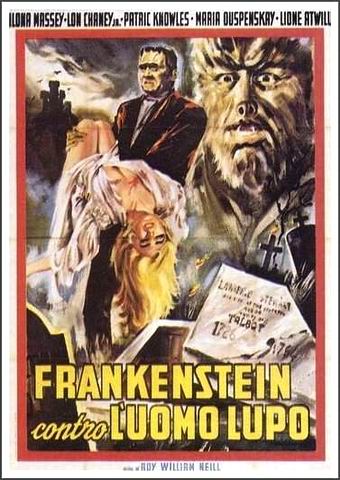
Frankenstein Meets the Wolf Man by Roy William Neill


Title: Frankenstein Meets the Wolf Man
Director: Roy William Neill
Years: 1943
Genre: Fantasy


The phrase from the Film: "But his is the q secret of life! This is not what I tried, I do not care about life! I am not an artificial creature I am a human being, I have human blood in my veins and I qualify that my life is mortal! "

Frankenstein Meets the Wolf Man was the fifth film in Universal to continue the saga of Frankenstein and the second film (and then direct the sequel) of The Wolf Man (1941). For the first three films in the series about the mad Baron (or Frankenstein, 1931; Bride of Frankenstein, 1935; The Son of Frankenstein, 1939 ) had been recognized as a significant creative factor, and the fourth installation, The Terror of Frankenstein (1942), had revealed all the limits history and the fact that maybe now the original was lost. One of the biggest problems was that the films contemporary to the Second World War many were deprived of funds and personnel, however, having to produce something, it is preferred to create clones or low-budget sequels that take advantage of previous successes. One idea was to merge the different series with each other. Frankenstein Meets the Wolf Man was the first of these products and this new "double size" brought a number of original productions at Universal, even if substantially the structure of the film was always the same: the monster returned to live, someone came back to take the place of Baron Frankenstein, the people rebelled and broke everything. Curt Siodmak, valid and well-known writer, but here it fails in an original way to merge the two worlds of monsters and this film ends up being more of a film "werewolf" and "from Frankentein. A closer look at the monster with the valve neck has substantial importance in the plot is really forced plus the fact that Talbot, the paranormal to solve a problem, has to resort to the knowledge of a scientist. Everything happens for logic matters little and rather melodramatic: the sudden change of mind of Dr. Mannering, has no reason to be, pass unnecessarily from wanting to eliminate the monster, wanting to expand. The cast is not bad and it is interesting to point out the various roles in which they found the same actors: Lugosi, who had refused to act in the film of 1931, states in the role of Ygor in The Son of Frankenstein is that The Ghost of Frankenstein. Lionel Atwill, memorable inspector from the wooden arm in The Son of Frankenstein made the mad doctor's assistant in The Terror of Frankenstein in this film while the role of mayor. Lon Chaney Jr. The Wolf Man was in the movie of 1941 and the Creature he The Terror of Frankenstein, but here again as a werewolf. Very confusing but especially poor creature played by Lugosi, probably the worst Frankenstein monster of all time. Also directed by Roy William Neill, known for directing most of the film Sherlock Holmes for Universal, that does not have the polish or the Whale by Rowland Lee. Frankenstein Meets the Wolf Man is not exactly a horror of "fear" but at least stop some stale rules of the kind that lets you explore new narrative, which, in truth, was not the way you would have hoped. The atmosphere of the old horror in melodramatic black and white, however, we are all. Film enthusiasts, in all cases recommended the purchase.

Barone on Universal's films and his Creature are: Frankenstein (1931), The Bride of Frankenstein (1935), Son of Frankenstein (1939), The Ghost of Frankenstein (1942), Frankenstein the Wolf Man (1943), Beyond the Mystery (1944), House of Dracula (1945), and the comic The brain of Frankenstein (1948).

MAYBE NOT ALL KNOW THAT ...

The first release of the film included Lugosi in the role of the monster, he said a few words. Sceening test, however, the public found that the emphasis of Lugosi (Hungarian) it was ridiculous coming from the mouth of the monster, so the lines of the plaintiff were canceled. It 's funny that Lugosi refused the part of the Frankenstein monster in 1931, precisely because the creature proferisse word (oltrettutto did not like that his face was covered with a heavy makeup). However, deleting dialogues, were eliminated riefrimenti the blindness of a monster, a side effect of the system in the brain of Ygor monster that you see at the end of The Ghost of Frankenstein (1942). Because of this fact is not even explained the stiff gait with his arms hanging out of the creature, walking will become a "trademark" of the film icon. There are several photos testify to the existence of the deleted scenes: for example, there are shots that show the creature and Talbot, which, next to a fire in the ice cave, they talk, it is then that Talbot and the public would know veut the creature is still blind. In the mid- 80s was performed a search in the warehouse of Universal to try to find prints or negatives of the original version but was never found anything.

Initially, Lon Chaney had to be part of the werewolf that one of Frankenstein's monster, but as a matter of time realized it was decided otherwise. Yet, in an interview later, Cheney argued that in some scenes had both monsters.

The first time you see the monster on the screen is not Bela Lugosi, but the stuntman Eddie Parker, who replaced Lugosi also in the fight scenes with the Werewolf.

The film was shot during World War II. The screenwriter and scriptwriter Curt Siodmak was a German jew escaped from Germany after the proclamation of the racial laws. Siodmak deliberately changed the place of the action from Germany to a place of fantasy called "Vasari," a name that could be loosely translated as "place of water", which refers to the presence of the dam.


Sreaming

Download

Monday, April 20, 2009

Xtreme-curves Galleries

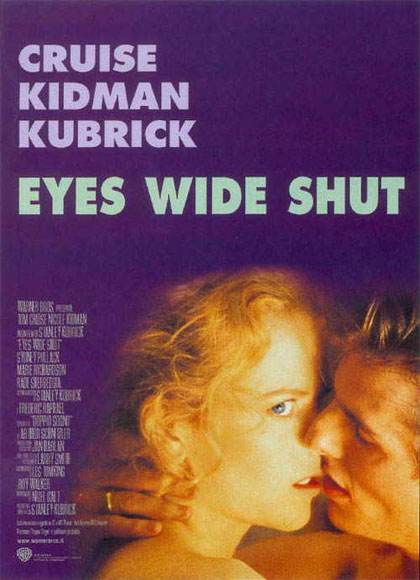
Eyes Wide Shut Stanley Kubrick


Title: Eyes Wide Shut
Director: Stanley Kubrick
Years: 1999
Genre: Drama


awaited, beatified a priori, this film has closed three parables, research, career and life. Kubrick's almost natural that, after so strict, total, manic and mystical commitment, it has not survived. It is another disturbing element of the myth of Eyes Wide Shut and author, who has done several films, addressing (and solving his own way) and that this theme of life and cinema. Here puts his seal, the ultimate truth about sex, which is certainly more important, to give just one example of science fiction. The film is based on a story by Arthur Schnitzler , Double dream , set in Vienna of the twenties, and transposes the story in the New York of today. Upper class, high property, nice houses, nice people. Cruise is the doctor William Harford, and Kidman is his wife Alice. At a party the couple and you woo woo (venial), but coming home she confesses that she recently proved an irresistible attraction for an officer. William seems to smile, but the revelation works on his conscience and in his nightmares. Imagine the wife in sexual acts with the officer. Change its relationship with sex, gives the court the daughter of a patient, out into the night and meets a prostitute, can not resist the temptation to participate in an orgy. Even sex with his wife turns. And his life changes. Because sex is a serious and mysterious, painful, and above all (and this is Kubrick) designed. Sex is certainly a long and strongly represented, but Kubrick has gained plenty of free artist (as Fellini), so the style all helps. However, the author, the American version, has hidden certain details. Could be understood as a sort of metaphor for the disdain of an American who chose to live in London and has long wanted to film in the U.S., the mecca of cinema: "the secret of the essence, I hold to the advanced European ". The rest is news now-legend, in fact: the almost three years in the making, then recruited some players protested, and as Keytel Malcovich, and the crisis of sexual double-some players, starting with the Tom-Nicole Queen torque. I wonder if it's all true.


Sreaming

Download

Sunday, April 19, 2009

Brown Patches On Utensils

PG sections, main use in administrative tasks?

Parliamentary question by Hon. Paladini (IDV) for all'improprio use of the Judicial Police to overcome the chronic shortage of staff, despite the prohibitions contained in the legislation.

Act Room

question for written answer 4-02474
by JOHN
PALADINI
Monday, March 9, 2009, n.142 sitting

Paladino. -
the Minister, the Minister of Justice.
- To know - given that:

Article 59 of the Criminal Procedure Code regarding the subordination of the Judiciary provides that sections of the police depend on the judges who run the offices to which they are established and that those in the sections not be distracted by the activity of police except under the provisions of the magistrate on which they depend;

several police unions have often complained that the staff of the State Police in the service of the sections of the judicial police is used in prevalently to carry out administrative activities in conflict with the provisions of Article 9 of the Implementing Rules of the Code of Criminal Procedure;

unfortunately, this happens due to the severe shortage of civilian staff in the police state -:

ministers questioned what measures are being taken to be ensure compliance with the rules, the dignity of each person called to participate in the justice system but also the staff at the Departments of Criminal Investigation, established at the public prosecutors, must be used in their duties and not in others not at all suited to the status of an agent / officer of public security and judicial police. (4-02474)

http://www.ficiesse.it/news.php?id=2983

Drinks Invitation Wording

2008 personal income tax, reduction of 134 € and Police personnel FF.AA

DPCM 27/02/2009, OJ 15/04/2009, N. 87
Friday, April 17, 2009

The rule provides for staff in the sector security, defense and public assistance, a reduction of tax and additional hands of a Decree of the President of the Council of Ministers 'identify the extent of reduction and its application methods. The DPCM 27 February 2009, therefore, identifies: • the recipients of the reduction in all military personnel of the Armed Forces (including the Coast Guard Corps) of the Police Force to order civil and military and the national fire brigade, who has received a in 2008 total employment income not exceeding € 35,000 • the extent of reduction in 134 € (not for the volunteers in serving with the Armed Forces and the national fire brigade, as well as for students of the academies, schools and colleges of education, gross fixed on tax reduction applies to half the total emoluments received); • Approaches application (the withholding agent shall apply the reduction in one solution to accommodate the tax calculated on the gross emoluments accessory paid, and any remaining amount, upon subsequent donations made during the same title). (DPCM 27/02/2009, OJ 15/04/2009, No. 87)
http://www . ipsoa.it /

DECREE OF THE PRESIDENT OF THE COUNCIL OF MINISTERS February 27, 2009 tax reduction provided for in Article 4, paragraph 3, deldecreto-law November 29, 2008, No 285 converted conmodificazioni by Law 28 January 2009, No 2.

1.Destinatari Art of the tax reduction
1. The recipients of the tax reduction redditodelle individuals and additional regional and municipal ofwhich art. 4, paragraph 3, of Decree-Law of 29 November 2008 No 185, ratified with amendments by Law 28 January 2009, No 2, to the extent indicated in art. 2, are all staff militaredelle Armed Forces, including the body of the Harbour, ilpersonale between police and military to civil order andthe staff of the National Fire abbiapercepito that in 2008 an income of employees, to finidell'imposta on personal income, total nonsuperiore to 35,000 €.

Art 2.Misura
a tax cut. In the period from 1 January 2009 and 31 dicembre2009, the gross tax on the treatment given economicoaccessorio, the fund paid to staff safety and rescue difesae public, and 'reduced for each beneficiariodell'importo euro.2 maximum of 134.00. The withholding agent shall apply the reduction of tax cuial in a single paragraph 1, to accommodate lordacalcolata tax on emoluments paid and accessory, perl'eventuale remaining amount, upon subsequent erogazionieffettuate year in the same way .3. For the purposes of this decree are treated economicoaccessorio entries pay treatment economicoaccessorio considered by the decrees of the President of the Republic of recepimentodegli union agreements and concerted measures under Article delpersonale. 1.4. For the volunteers not in permanent service and the national armed delleForze of firefighters, as well as 'toMember pupils in academies, schools and colleges diistruzione, according to its law, the security industry, defense and relief, reduction of taxes provided for in paragraph applies 1si on tax gross fixed on the prize' trattamentoeconomico the total received.
Rome, February 27, 2009
Join the ECA March 25, 2009

Reverse Roulette Torrrent

What Just Happened Barry Levinson


Title: What Just Happened
Director: Barry Levinson
Years
2009 Genre: Comedy


Two weeks in the life of Ben, a Hollywood producer, who, besides having to face a second divorce never fully accepted, in front of him him two projects definitely not simple. In the first case it is a film director mounted a particularly irritable and attached to their work. The star Sean Penn in the final but must die before him, and his faithful dog to make a bad finein foreground. Prewiew of the public does not like and even less appreciated Lou, head of the study that would distribute the film. Can Ben convince the director to remove the offending scene?
The second problem is that Ben has to face is equally complex: it has a film in preproduction with Bruce Willis character. The actor, who has grown a flowing beard that makes him almost unrecognizable, has not the slightest intention of tagliarsela. Those who should invest their dollars in the project is ready to cancel all contracts (and related penalties for Ben).
It is from these situations that unravels a story that sees De Niro to bring into play all his histrionic talents confronted with a stellar cast in which two colleagues (Penn and Willis) perform the role with great self-mockery of themselves. The mechanism
narrative film in the cinema seemed so repetitive and worn that it can not find new routes. Barry Levinson has shown that it is not so much avoiding the winks to professionals and proposing a comedy that can entertain the general public who called with a smile to spy through the keyhole of the 'golden' world of Hollywood, one can see how each film (especially in that car tritasassi which is the Mecca of the Movies) is the result of a variety of dynamics that will not always act in favor of its success.
fun to hit in front of characterizations Turturro and Tucci and exit do not feel ashamed of having done so, as unfortunately happened to the international critics at Cannes who attended the screening, smiling and often laughing, but eventually denied the applause.


Sreaming

Download

Laura Gemser Streming

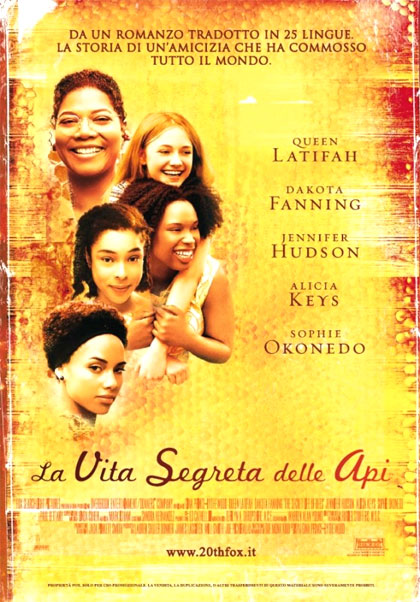
The Secret Life of Bees Gina Prince-Bythewood


Title: The Secret Life of Bees
Director: Gina Prince-Bythewood
Years
2009 Genre: Drama


has certainly not all the security of the world that the little Lily in 4 years shoot the mother by mistake and is forced to pass the following 10 years with a father who does not love her and never fails to point it out. So when the measure is full escapes and embarks on a journey in search of their roots (in the footsteps of a similar one made by the mother) together with her carer with their own color in the year of signing of the declaration of civil rights for African Americans. To receive her into a new bed three sisters will be familiar to those who produce honey, but Lily will learn that despite the well-being is one thing to sign a piece of paper is one thing to make it come true.
Funny how the first scene of The Secret Life of Bees is clearly identical to the opening of Mean Streets. It is the only point of contact between an independent film and disruptive as that of Scorsese and this soothing and reassuring that requires the viewer to teach his views in small pills of poetic wisdom put into the mouths of actors (for mostly farmers) and the many emotional blackmail. In this sense, it proves to be very honest the choice of a title (borrowed from the book which inspired) from the documentary school.
is the typical modus operandi by which America reflects its own history and handed down to the cinema. Not from the standpoint of its operation (or that of his reading as we usually do we) but the sentimental point of view. The subject of the film are not the facts that led to the signing of the Declaration nor the civil rights battles of African Americans (there is some reference to pop up to frame the question) but what it meant everything emotionally.
To achieve this the director Gina Prince-Bythewood choose a star cast of color (mostly singers) and relies only on it. All that the film aims to communicate through the actors, there are no other solutions for a director POSSIBLE totally anesthetized slumber on their faces. Good thing to write a scrap of credibility to everything there is Dakota Fanning, who at 14 years is one of the most extraordinary dramatic faces that can be considered today.
Everything in the film meets the viewer to confirm what he already thinks and strengthen their ideas. The casting (the matron in the flesh, the beautiful young activist and her sister a bit weak 'ugly but the big smile), characters (all one-way and no evolution), the plot (which comes up while all'implausibilità not surprising) and the feelings involved ("I Want To only to be loved by somebody! ").
The Hollywood reinterpretation of emotional history of the country is also a form of archetypal tale that has its fixed masks and The Secret Life of Bees it does not escape to reach a the target (a smile for every tear) in the most easy and safe. dilutes any unexpected conflict and softens even the most bitter and dramatic moments in time before announcing them to show them, so as to spoil the viewer while still reassuring sound of a simple smile and hold tears.


Sreaming

Download

Friday, April 17, 2009

Do Mcdonalds Own Their Suppliers

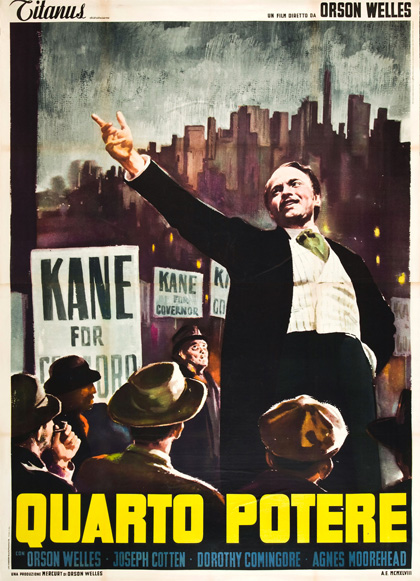
Citizen Kane by Orson Welles


Title:
Kane Director: Orson Welles
Years
1941 Genre: Drama


Kane arouses admiration, wonder and the kind of stunning that you always test the presence works of art which warns that know how to communicate and express even beyond expressing.


If there is a movie in film history in black and white predopoguerra, of which he can preach it has been fully built into the script, the staging and framing of the post and profilmic editing, this film is certainly Kane, the first feature directed (and performed) by Orson Welles in 1940 was only 26 years. Before Citizen Kane - the title of the movie - the cinematographer Welles had experienced a first attempt in adolescence than four minutes, entitled The hearts of age, along with direct in '34 William Vance, and then Too that Johnson, 40 minutes, shot in '38 for a representation of the Mercury Theatre in New York and, in fact, never presented to the public. Surprising, then, that in '41 - at the hands of a talented young man already recognized for theater and radio experience, but certainly not too experienced in the affairs of cinema -, has given birth to a film that still seems to touch perfection, even if the work should be recognized, then passed over in silence - apart from a more skilled critical acclaim - and represented in all essence, a commercial flop . In fact, even more so to the scrutiny of repeated visions, Kane arouses admiration, wonder and the kind of stunning that you always test the presence of works of art which warns that even know how to communicate and express the other side of 'expresses.

Trying to break down and watching a fabric of signs that - let's just - does not seem to find any point of view, a methodological approach that can reduce a unique interpretation the exuberant richness of a text very articulate, it can be said, however, that the first quality of Citizen Kane - that, somehow, can not jump to the eyes - is its symmetrical composition. In this perspective, beyond the usual analytical focuses on the symbolic echo of the word Rosebud (which, of course, Parliament), the sign of the truest sense of the rich and, together, be heard in the film - be heard because In his letter, he denies that the film will have access to any kind of meaning can be expressed and, therefore, poses in film and cinema as deemed reliable means of communication of knowledge - is quell'inquadratura a little 'crooked that, immediately, at the beginning of the film, focus a sign affixed to the fence to protect the estate of Xanadu, that says no trespassing and repeating itself to seal the work at the end of your movie . At first, the camera gets up with a dolly to exceed the height of the sign and the fence, as if to say that you try to go and discover the mysteries behind Xanadu and its creator. In the end, the dolly down again, the area along the fence, to reframe that sign that now makes sense bursting, as if to say that the whole film, then, is right on a beautiful illusion to understand in depth the individual reality character of Charles Foster Kane: do not, however, already announced at the beginning, from that sign that said, in fact, No trespassing, not to exceed, or even not to go there, because, so, beyond the fence, there is no way to recover the truth about the facts and men, but only - as a character at the end of the film - the chaotic collection of bits and things that go to make a puzzle which will, however, always a joint.
short, Kane in early film, states with the movement of the camera that violates the prohibition of trespassing No, the right and duty of the medium of cinema experience to restore a sense, by means of the investigation, the noumena of reality, to deny to the end, however, this same assumption and state, sealing the work with the symmetrical repetition of this initial signal, that reality is unknowable, at least in depth, and what you can say concerns only the surface, the phenomenon, that is what you can see without having the ambition - or hubris - of trespassing.

By means of the investigation, said. Why, in fact, Citizen Kane, a diegetic point of view, unfolds as a study conducted by a group of journalists to try to more accurately portray the figure of Charles Foster Kane - played by Welles himself -, as controversial media magnate, politician, columnist and owner of a huge business empire, whose recent death, implantation of the film narrative, there is, indeed, as a pretext for a rethink as well as a period in American history, not least of the contradictions of a personality titanic perpetually on the border between Good and Evil, or, rather, between love and hatred of his countrymen. So, after the highly stylized and synthetic narrative of the death of Kane, now alone and left to fend for himself in his palace at Xanadu - in a dreamlike sequence marked by traces of an expressionist style almost recovered the letter -, here, with a sudden change of gear, the film presents News on the March a cinedocumentario shot by some journalists do not know which head about life and death of Kane. Not only is the documentary screened, almost like a film set in counterpoint to the opening sequence, produces a kind of shock perception, with its relentless voiceover says that apparent images footage mounted with dizzying pace of vintage newsreel, producing one of those hopping style that will prove to be, then, a constant for that patchwork that is Kane . And not just the film, then, looks like even the second investigation, given that the journalists protagonists of the film - and especially Jerry Thompson, who will function through which you try to mend the pieces of a personality that, as we said, will never come in its entirety - carry on with the real life of a ' objective, precisely, to integrate an existing reconstruction cinegionalistica than life itself. Above all, the newsreel will immediately roll out the limits of knowledge of the medium film. At the end of the projection, in fact, the editor Rawlston will be forced to say that the document is incomplete, because it tells what Kane has done and not who he really was - to say that cinema is at ease in recounting the actions of but men are uncomfortable in reconstructing the comprehensive psychological profiles of his characters. And here we find, then, the big news of the first and final feature film of Welles. Because the target for journalists News on the March, it will then get to the essence of man groped for Kane, to understand, at maximum depth, the fundamental reasons that had caused her life, in terms of action, had manifested itself in a certain way rather than another. That is, in short, that Citizen Kane is configured, perhaps, as the first great film overtly psychological, if not psychoanalysis, the history of cinema, because, precisely, the idea that moving the characters / journalists who are investigating Charles Foster Kane starts from the premise that the truth of a man lies in his emotional lump in his psychological quality, which discovered the truth then that is the essence of man can not come to light. It is, in other words, research is not so much of character, which, in the history of psychology, especially in the footprint of the Enlightenment, is a coherent set of features and therefore prone applicants, natura rerum, a classification process more or less summary ; it is, rather, the exploration time to seize the unique individuality of the person, his unique and unparalleled quality in a manner that the psychological approach that ultimately does not seem to have much to do with Jung - at least in the Vulgate Jung - little by Freud tended to summarize the types of complex, and, instead, with the spiritualist philosophy that, by Leibniz Bergson, had industry to recognize in every human being, the singularity of the monad or the image-quality movement that performs its opacity in the whirlwind of that metaphysical plane of existence (the world) and other saturated by an infinite number of images -movement. We'll see, then, that, however, to a level a bit 'more superficial, Freud, apparently excluded from the scene, it will eventually come into play. The fundamental fact, however - also symmetrical to the dolly initial climbs over the fence - is that Kane in its diegetic structure - namely the investigation launched by Rawlston and effectively fulfilled by Thompson - has the ambition to identify the most appropriate way possible, the psychological depth of a character. Assumption held, then, also from the narrative but, as we have seen, denied at a level on the symbolism - all for a film built on the denial of the statements expressed - by the twofold occurrence of that No trespassing, in the light of these last considerations, it acquires - a reinforcement - so effective performance with respect to metalinguistic awareness on the capabilities of knowledge Film (but I would say: the human being as subject of knowledge) to be attributed to the film's debut Welles not only the value of a work of art but also of modern philosophical thought. The investigation

man Kane - rather than the public: how, instead, would assume the original title - focuses then on the symbolic value of revelation that can have the last word uttered by Kane for a moment before you die : the word is Rosebud, clumsily translated Italian version Rosabella. The hypothesis of Rawlston, Thompson and other journalists obeys the following postulate: deep understanding of the importance of quality and personal term Rosebud you can finally give to those who have given a specific quality and not contingent, individuality now clear that it will go well beyond the troubled and enigmatic complex of features that emerge from the analysis of chaotic practice actions of the character Kane. The whole secret, then, in a word, according to an almost medieval studies semiotics impression, as if, indeed, one could argue that res sunt appointment and that the words contain meanings and meaning so comprehensive as to render comprehensible with their simple occurrence, the world as macrocosm, or at least that world, limited in time and space, which is the microcosmic existence the human being. Yet another illusion, as we shall see, because the revelation of the meaning of Rosebud - granted privilege of knowledge, however, only for us viewers - we simply get an idea of \u200b\u200bthe origin (this time Freud) of certain peculiarities of character of the Kane character, without However, to argue that everything we know about Kane can really be explained, and to some extent, reduced to the echo of the metaphorical term Rosebud. " not just a word to explain the mystery of a man " declaims the end, so perhaps overly didactic, that Jerry Thompson, who has not been able to reconstruct the puzzle seems to be in Rosebud, Now, nothing if not one of the many missing pieces. And we, though we know that - or they're going to know - more than that, we can only nod and acknowledge the fundamental unknowability of the quality of reality and human nature.

But the film, as mentioned, is the investigation and the investigation was made puzzles, in search of cards that can rebuild the mosaic - and, moreover, the puzzle will be the last part of the emerging figure of speech film, especially since the puzzles will become the favorite pastime of the second Mrs. Kane and, from a diegetic point of view, the investigation macrofigura puzzle is manifest, therefore, in the joints produced by five different interviews with persons who lived close to the epic story of Kane. The five different interviews give rise to five different flashbacks - which thus becomes the narrative device of choice for Citizen Kane, used, however, with so much expertise and cross-references to anticipate, to some extent, what, in the Fifties , will be the true masterpiece of film flashback, namely Rashomon by Akira Kurosawa.
From the first interview, the banker and mentor Walter Parks Thatcher (interviewed by default, we might say, for him, in the austere room of the Library Thatcher, Thompson merely to review the pleadings, that even introduce, autographed items directly from the manuscript - amazing bold for its time! - Flashback authentic information on childhood and early youth of Kane) - we learn to recognize the state of infantile serenity Kane's child, in his snowy log cabin, lived with his parents, in a backwater of the Colorado, but we come to be informed, too, the contradictions of education imparted in a somewhat 'paranoid and anxious to be a caring mother and a father foolishly free-range but weak and authoritarian, and, finally, discern - almost from the beginning of' Inquiry -, what was the trauma of trauma, namely the separation from parents, who came in possession of a huge fortune, decide, precisely, to instruct the young Charles to the protection Bank of Thatcher, so she can grow in attendance of the best schools in the world to come prepared, then, at the stroke of full age, to the duties of directors of one of the most important economic fortunes of America. This is a plunge in medias res, then, because right now we know that Kane has been, even at the age of ten years, the maximum disturbance of which may suffer a child to be abandoned without love in every little entitled, in exchange for the promise of a fortune too much material to come within the horizon of the here and now of childhood. Kane baby, in short, an increase in the Trauma of Love, and suffers the pain of being dropped from the status of subject He loves it and wants to be loved than the object whose value is given only as an investment intended to yield huge economic benefits: a devaluation of the value of the person who will always remain - as we shall see - every little action or emotion of Kane made man.

Thanks to the viewpoint of the character of Bernstein - played by an incisive Everett Sloane -, Kane shows us the face of strong-willed man, enterprising and bold. Bernstein was, for decades, the editor of the newspaper office of Kane, that "New York Inquirer, through which the volcanic character of Welles has challenged the views, beliefs and emotions not only of citizens but of all the 'America and, to some extent, even the Western world. From the accounts of Bernstein is impossible not to understand that the newspaper, Charles Foster Kane, was the preferred means of which the publisher and the reporter had tried every possible way to convince the public - or at least a majority of the public - the fact that their words and actions were always dictated by a sincere love for others and for that reason, our neighbor, whoever he was, could not help returning to Love Charles Foster Kane. " Kane has always done everything for love " whispers Bernstein during his interview with Thompson ' and love has always lost all that had happened to possess . Formula Summary but precise to define the specific character of the compulsion to repeat Kane, who has always led, almost like a machine, to retrace that route of love and loss that had marked so deep - as we have seen - the time highlight of his childhood. The newspaper then, and the press in general - the "fourth estate" of the Italian title misleading - it shows, then, in the only real function they want to accomplish, beyond any other consideration of sociological or political patch up with the affection of the faithful readers of every day, ripping a native of that love lost too soon.

Jonathan Leland - which gives the face a young Joseph Cotten already persuasive and elegant - Is the third interview. It was Kane's childhood friend, the longtime companion, comrade and confidant with whom Kane had maramaldeggiato from Urchin unrepentant, colleges most important in America and Europe. Kane, had shared the adventure of the birth, growth and explosion of popularity of the New York Inquirer, becoming, from the beginning, the acclaimed dramatic critic. Also, during World War I, had been among the major activists of the campaign advisors and Kane for the race - failed - to the governorship of New York. In fact, however, the important role of Leland is, above all, to represent, as full as the story progresses, the sign of a conscience in opposition, if Kane can be mirrored with the certainty of finding in it all the contradictions of his being, moreover, clearly enunciated by Leland, enucleated with order, Cotten's character seems to gain, so the role of the psychoanalyst internal to the diegesis, the one that lays bare, even and especially in front of Kane, the insecurities and inner conflicts of the protagonist. Not surprisingly, Kane always feed, against Leland, a sort of sublime love, then, come to think, is very similar to the feeling of transfer that Freud was even necessary element in the relationship between patient and analyst. The balance, honesty, serenity, the irony and bastevolezza that distinguish himself, throughout the film, the character of Leland enter, minute by minute, increasingly at odds with the rising of neurasthenia Kane and act, so to speak, consciousness critical of dishonesty in the desire d ' display of honesty which is typical of Kane, or temporary price control than the obsession to be loved that is the hallmark of the psychology of the protagonist and who makes it, quite rightly, one of the first characters of the completely neurotic Film History, or, also, against severe censor of the most naive and melodramatic Kane's personality, traits that emerge, with strength, for example, opposition the trap of self-defeating Gettis - that will ruin his political career - or very decomposed in the reaction to the abandonment of his second wife.

's second wife, in fact. Susan Alexander is the fourth respondent - but, ultimately, the story of her marriage to Kane does not add much to what, at this point in the film, Kane already know. The story of their love affair as to reinforce and hound work more closely the outcomes of the psychology of extreme controversial protagonist in his relationship with Susan Alexander, Kane reaches its peak apex is wanting to be loved at all costs (and superhuman efforts aimed titanic to become an opera singer Susan obey the dual purpose to realize a dream of the young woman to do so more intensely you love but also love to collect the consent of the public this time through an intermediary: his wife, in fact) is self-destructive tendency in isolation from the world, that 's in fact, is triggered when the protagonist realizes that the world does not want more (it becomes imperative, then, the choice of escape in monstruum architectural Xanadu: the definitive abandonment of the real world, too anarchic in his indomitable mutability, for a universe and artifact built a beautiful place, packed with fetishes, idols and statues but safe and sound in its deathly stillness). Susan, then, gives us a joke that is perhaps the most beautiful in the film and to some extent, the most significant. When Thompson during the interview, he told Susan " know I feel a bit 'of punishment for Mr. Kane? , "she raises her eyes to heaven, in typical posture of melodrama, and then almost whispering under his breath, let the emotion flow into that" And I not? 'exact words that represent the synecdoche of the feeling that arises, and can only arise from the principle of spectator identification.

By the last interview, that is subjected Raymond, the butler of Xanadu - only apparently marginal figure - the circle (at least for us viewers) finally seems close. Raymond said, in fact, Kane, shocked by the unexpected flight of Susan Alexander, was first left to go to a fit of anger and despair which had prompted him to mess up the room of his wife. In fact, Raymond gives (at least to us viewers that we will have the leisure to be able to see the final shot) the tools necessary to understand the final, finally, the mystery of Rosebud , tells us that in its destructive fury immediately resulted in the abandonment, Kane was quelled only and only when, among the ornaments of his wife, had come across a glass ball inside the landscape with a house surrounded by the snow, and that, and hold the object, with tears in her eyes, she whispered for the first time the term Rosebud, which then, as mentioned, will give back a moment before his death. That word, then, becomes an index. In a sort of psychological fitting that we viewers we can not but do now that we understand that term, of course, has much to do with the memory of happy childhood in Colorado and, conversely, in ambivalence is typical of the feelings deeper, with the Trauma of Love lost. Rosebud is an entity that probably should be part of the state of original bliss lived in her parents' house, at the same time, however, over the years, that same entity had accumulated on himself all the emotional pain of the tear, going to be a symbol of loss of love, as we have seen, is the psychological complex that moves all the steps of Kane. For us viewers, everything is finally clear when, among the many objects that had belonged to Kane and, finally, in the final eviction of Xanadu, are thrown into the shredder, we can see, the flames of a fireplace burning statues, jewelry and junk, an old worn shoe - which is certainly the sled Kane had played with as children in Colorado - which, incidentally, before the fire to take root, we can read, right, the word Rosebud. Here then, is the secret: Rosebud is an old tool of play that, over the years, has taken the fantasy value of transactional object or fetish that hides the lack of, but hiding it, and the exhibits, under the plaster, for the obvious metonymy, and such failure - now we know - is that of ' Love never found.
is then that the film is revealed at the end of his playing time, that is conceived as a work on the fragments, symbols and fetishes that in some cases, the best expression of a personality. These pieces - beautifully suggested by the structure of the puzzle diegesis - reconstruct in retrospect of identikit individuality whose original and constant fear is precisely the fear of loss of love (in a sense strictly Oedipal: the Terror of the loss of love of the Mother) and whose desire is to find the fullness of love lost: the desire for a never find satisfaction, to the extent that the lost love has so diaphanous quality and well it can not be traced in the Real, but only and only at the level of expression of the Regime, a-concrete and abstract, symbolic of the human being. Here, then, ultimately, the tragedy of Kane: the unending search of a love that, because of his belonging to a kind of metaphysics of personal memory, is condemned to never being able to be reached. We know, however, that this reading, we have just illustrated, the complex of Love Kane is just one possible aspect of the interpretation of a personality that, as such, is always beyond the knowable and expressing: this will be the conclusion, finally, come the investigation of Thompson, confirmed, however, all 'beginning and end of the film, the repeated occurrences of that No trespassing, which appears to us, so - as we have already said - a sign that contains, in very concise way, the true meaning of the work's debut Welles.

Some stylistic choices of Toland and Welles - the director of photography - confirm, indirectly, the idea - anti-realistic - that the real is to do some investigation as long as you have no claim to identify a unique sense of reality. The latter, for Welles, he has always an infinite number of planes of space and time, and in this labyrinth, be known to be irretrievably lost. From this point of view, the almost obsessive insistence with which Welles and Toland choose to take in depth of field is to put it mildly symptomatic. If the reality of things is this lump inextricable infinite organization whose criteria are inherently irreducible to any human knowledge, then it is clear that the real should be watched with the utmost respect; Wherefore, translated into the technical equipment of the early '40s meant having to choose, especially, the amplitude of the focal targets wide-angle, which allowed widespread clarity to the whole scene, on different spatial planes, however, demonstrating, in fact, that the reality of a living truth that must be taken as a whole, because a split would undermine the reality of its plurality of meaning . Resume reality in depth of field, with many plans sequence where the characters are to be left to act, helps to give an account of reality, of course, this is a stylistic feature of a paradoxical kind of Welles the filmmaker, who has always rejected realism as the greatest of lies, but it is a paradox that finds its reason, finally, the need not to frame the reality within narrow margins as they would, precisely, with the real steal its constitutive plurisemanticità. A striking, then, a second choice of style, which appears to conflict with the first: that is, the expressionistic lighting, constantly suspended between light and dark, and shoot with the power of electric lights from the theater, on the faces and on the bodies of the characters. Lights delegated to illuminate your surroundings while they seem to obey a logic that wants to be darkened faces: as if to say that man is essentially immersed in the shadow of its intentions and in the darkness of his fate. Just think of the opening shots after the screening of the documentary - the faces of the journalists who do the investigation on Kane and come out into the light, as if to anticipate the outcome of the investigation, or the clear division of light that saturates the room where the library Thatcher Thompson reads the manuscript of the guardian - to suggest, through this symbolic and evocative lighting, congenital ambiguity of the character of the banker - or, at the meeting, with Gettis - sequence fully immersed in the shadows, because Gettis is the first of a humanity that can not fill frightening darkness of all environments in which it finds itself act.

Realism - or, rather, the depth of field - is the expression converge, then, to build a new stylistic system and indecipherable: made more Overall, however, by sudden surges of assembly in which Welles decides to tell, by analogy, concise, all the events on which is not going to dwell too much important moments, though, because they serve to advance the story by means of short narrative sketch, perhaps, illustrate in a whole brevity of wit. Here, then, the emergence of fast edits, documentary-style, functional communication of synthetic beats and highly significant or action outside the field of voice-overs. And yet here is the occurrence of mounting a bit 'more educated, sometimes built sull'assonanza bold framing - unwise to jump in time and space photography Chronicle of writing went all ' Inquirer - and sometimes on the principle of metaphor - think of the dove flying away when Susan Alexander escapes or light suddenly goes out to predict the suicide attempt of the same Susan. All in patchwork form that, in fact, that is Kane : perfect film unit constructed and, paradoxically, the game continued and uninterrupted style jumps.


Sreaming

Download

Thursday, April 16, 2009

British Mature Girdles

DECREE SIGNED AUTHORIZATION FOR PAYMENT OF OVERTIME


UIL STATE POLICE: DECREE SIGNED AUTHORIZATION FOR PAYMENT OF OVERTIME 2009.
Rome, 15 April - The UIL State Police is aware that the Prefect Antonio Manganelli, granting the request of several interested parties, urged the Ministries competent. In these hours, after the necessary clearances from the Ministry of Economy, authorized the payment of the outstanding service provided in the first quarter of 2009.

Tuesday, April 14, 2009

Chicken Wings Bulk Uk

Che - The Argentine Steven Soderbergh


Title: Che - The Argentine
Director: Steven Soderbergh
Years
2009 Genre: Drama , Historic


On 26 November 1956, the Argentine doctor Ernesto Guevara sails to the island of Cuba with a young lawyer named Fidel Castro and 80 more rebels determined to overthrow the dictatorship of Fulgencio Batista with a revolution. Doctor, strategist and tireless fighter, the "What ", leading a column of men, after a long period of exhausting the Sierra Maestra , conquer the city of Santa Clara and meet comrades to march on L 'Havana.
What appears on the screens, after eight years of work, What is the of Soderbergh, what no one else could do in a similar way, what the author Soderbergh and producer bears the indelible mark even where it treads new paths, and also just because it tramples on them. Breaking up the conventions of continuity, with an ex back and forth in time (looking back to the terrace of the first meeting with Fidel) and movements in space-from tropical forest to the United Nations Headquarters - that say a lot about the versatility of the protagonist, Soderbergh also speaks of himself, of his films, which bounces between exploration and diplomacy, including images UltraVivid adventure (filmed with Redcam) and those declined in glamorous black and white branded North America and society of the spectacle.
are two tracks: on one hand makes its way a leader, asthma and strokes among the enemies of the rifles, the other a star is born, under the flashing cameras and interviews romantic. In this sense, in his film anything but respectful and declamatory, the director takes a clear stance by saying that it is not the goal (the) interest, not the icon, but the journey.
The character of Che Guevara (re) born into the body more massive than Benicio Del Toro (light years away from the sensitive kid Motorcycle Diaries) and is built on actions, tone of voice, fury of the gaze: first film with guns than with those of history. Unfortunately
Che - The Argentine not fully appreciated due to a dubbing that has no reason to exist, leveling, decontextualized, alter the character of its foreign character, and because it is probably as a film-experience in its total duration of four hours and the desired gap between the two component parts, which is enriched with meaning. Besides, what makes Soderbergh is exactly that: to enter the experiential dimension of the revolution, to the rhythm of the steps tired of sleepless nights, the decisions to be taken at the time, the errors for all, to tell a man who made a practice of an idea, to expose us, in practice, the idea of \u200b\u200bcinema.


Sreaming: Part 1, Part 2

Download
: Part 1, Part 2

Thursday, April 9, 2009

Eagle Scooter Wheels Canada

2009 Bridge to the Abruzzo


Our Association is coordinating a collection of accessions to provide assistance to populations affected by the terrible earthquake of Abruzzo.
Anyone willing to give their availability for eventual use in the field (on a voluntary and FREE of service) for assistance or anything else deemed necessary by the Civil Defence Department, is requested to give Instant communication at the address below. Once quantified
our strength will be available to the Central Office of Civil Defense to establish timing and mode of action.
Director: Francesco Zavattolo e-mail: francesco.zavattolo
@ gmail.com Contact: 340 2917923 - 331 5736725

Info: www.ficiesse.it

Sunday, April 5, 2009

Vista Driver 5069-6732

Review "diseconomies" between police and Carabinieri

SAFETY: Maroni, REVISE ORGANIZATIONAL FORCES MODEL PS (ANSA) - ROMA, 2 APR - The''competition''between police ecarabinieri territory creates diseconomies''sometimes''and, therefore, and 'an organizational model that''needs to be reviewed.'' It and 'Interior Minister Roberto Maroni convinced that, at a hearing in anti-Mafia commission, also stresses that the problem for the next few years will not be' tied to economic resources so as to human ones, as many policemen and police officers will retire.''My concern - the Interior Ministry said the owner - does not affect the economic resources but human resources, and not for il2009 but in perspective for the next five years because 'there will be' a reduction of police and carabinieri, made thirty years ago, who will retire.'' E-adding''I do not think - that they can take 20 thousand policemen and carabinieri in the next 4-5 years.'' Hence the need 'to''rethink''an organizational model dating back to 1981.''I'm not versed in the controversy, which 'was revived in these days, that the Carabinieri must pass under the Ministry of Interior. I do not say anything about this,''pressed Maroni, who continued:''But 'the organizational model that sees a sort of competition in the territory between the police and carabinieri leads to diseconomies that must be overcome.'' E ', the current one,''a model that has worked in recent years, but now must be modernized.'' The minister takes the case of the province of Reggio Calabria to make a practical example. Li, 'he says,''there are 91 presidents of the policemen on 97comuni. In practice, a policeman every 322 inhabitants, when the national average and 'one in every 700. This concentration of them 'and' useful and even enough - he concludes - but 'has' made in time and is part of a model that should be reconsidered.''