Title:
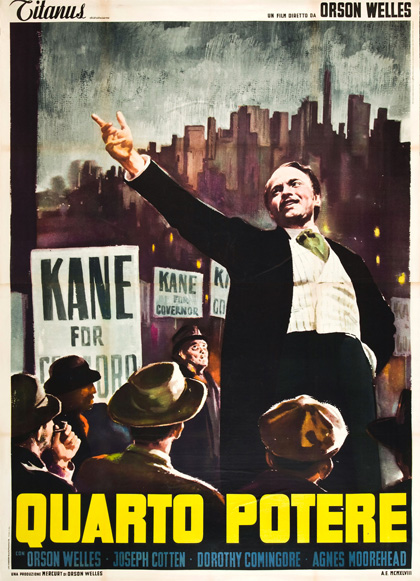
Kane Director: Orson Welles
Years
1941 Genre: Drama
Kane arouses admiration, wonder and the kind of stunning that you always test the presence works of art which warns that know how to communicate and express even beyond expressing.
If there is a movie in film history in black and white predopoguerra, of which he can preach it has been fully built into the script, the staging and framing of the post and profilmic editing, this film is certainly Kane, the first feature directed (and performed) by Orson Welles in 1940 was only 26 years. Before Citizen Kane - the title of the movie - the cinematographer Welles had experienced a first attempt in adolescence than four minutes, entitled The hearts of age, along with direct in '34 William Vance, and then Too that Johnson, 40 minutes, shot in '38 for a representation of the Mercury Theatre in New York and, in fact, never presented to the public. Surprising, then, that in '41 - at the hands of a talented young man already recognized for theater and radio experience, but certainly not too experienced in the affairs of cinema -, has given birth to a film that still seems to touch perfection, even if the work should be recognized, then passed over in silence - apart from a more skilled critical acclaim - and represented in all essence, a commercial flop . In fact, even more so to the scrutiny of repeated visions, Kane arouses admiration, wonder and the kind of stunning that you always test the presence of works of art which warns that even know how to communicate and express the other side of 'expresses.
Trying to break down and watching a fabric of signs that - let's just - does not seem to find any point of view, a methodological approach that can reduce a unique interpretation the exuberant richness of a text very articulate, it can be said, however, that the first quality of Citizen Kane - that, somehow, can not jump to the eyes - is its symmetrical composition. In this perspective, beyond the usual analytical focuses on the symbolic echo of the word Rosebud (which, of course, Parliament), the sign of the truest sense of the rich and, together, be heard in the film - be heard because In his letter, he denies that the film will have access to any kind of meaning can be expressed and, therefore, poses in film and cinema as deemed reliable means of communication of knowledge - is quell'inquadratura a little 'crooked that, immediately, at the beginning of the film, focus a sign affixed to the fence to protect the estate of Xanadu, that says no trespassing and repeating itself to seal the work at the end of your movie . At first, the camera gets up with a dolly to exceed the height of the sign and the fence, as if to say that you try to go and discover the mysteries behind Xanadu and its creator. In the end, the dolly down again, the area along the fence, to reframe that sign that now makes sense bursting, as if to say that the whole film, then, is right on a beautiful illusion to understand in depth the individual reality character of Charles Foster Kane: do not, however, already announced at the beginning, from that sign that said, in fact, No trespassing, not to exceed, or even not to go there, because, so, beyond the fence, there is no way to recover the truth about the facts and men, but only - as a character at the end of the film - the chaotic collection of bits and things that go to make a puzzle which will, however, always a joint.
short, Kane in early film, states with the movement of the camera that violates the prohibition of trespassing No, the right and duty of the medium of cinema experience to restore a sense, by means of the investigation, the noumena of reality, to deny to the end, however, this same assumption and state, sealing the work with the symmetrical repetition of this initial signal, that reality is unknowable, at least in depth, and what you can say concerns only the surface, the phenomenon, that is what you can see without having the ambition - or hubris - of trespassing.
By means of the investigation, said. Why, in fact, Citizen Kane, a diegetic point of view, unfolds as a study conducted by a group of journalists to try to more accurately portray the figure of Charles Foster Kane - played by Welles himself -, as controversial media magnate, politician, columnist and owner of a huge business empire, whose recent death, implantation of the film narrative, there is, indeed, as a pretext for a rethink as well as a period in American history, not least of the contradictions of a personality titanic perpetually on the border between Good and Evil, or, rather, between love and hatred of his countrymen. So, after the highly stylized and synthetic narrative of the death of Kane, now alone and left to fend for himself in his palace at Xanadu - in a dreamlike sequence marked by traces of an expressionist style almost recovered the letter -, here, with a sudden change of gear, the film presents News on the March a cinedocumentario shot by some journalists do not know which head about life and death of Kane. Not only is the documentary screened, almost like a film set in counterpoint to the opening sequence, produces a kind of shock perception, with its relentless voiceover says that apparent images footage mounted with dizzying pace of vintage newsreel, producing one of those hopping style that will prove to be, then, a constant for that patchwork that is Kane . And not just the film, then, looks like even the second investigation, given that the journalists protagonists of the film - and especially Jerry Thompson, who will function through which you try to mend the pieces of a personality that, as we said, will never come in its entirety - carry on with the real life of a ' objective, precisely, to integrate an existing reconstruction cinegionalistica than life itself. Above all, the newsreel will immediately roll out the limits of knowledge of the medium film. At the end of the projection, in fact, the editor Rawlston will be forced to say that the document is incomplete, because it tells what Kane has done and not who he really was - to say that cinema is at ease in recounting the actions of but men are uncomfortable in reconstructing the comprehensive psychological profiles of his characters. And here we find, then, the big news of the first and final feature film of Welles. Because the target for journalists News on the March, it will then get to the essence of man groped for Kane, to understand, at maximum depth, the fundamental reasons that had caused her life, in terms of action, had manifested itself in a certain way rather than another. That is, in short, that Citizen Kane is configured, perhaps, as the first great film overtly psychological, if not psychoanalysis, the history of cinema, because, precisely, the idea that moving the characters / journalists who are investigating Charles Foster Kane starts from the premise that the truth of a man lies in his emotional lump in his psychological quality, which discovered the truth then that is the essence of man can not come to light. It is, in other words, research is not so much of character, which, in the history of psychology, especially in the footprint of the Enlightenment, is a coherent set of features and therefore prone applicants, natura rerum, a classification process more or less summary ; it is, rather, the exploration time to seize the unique individuality of the person, his unique and unparalleled quality in a manner that the psychological approach that ultimately does not seem to have much to do with Jung - at least in the Vulgate Jung - little by Freud tended to summarize the types of complex, and, instead, with the spiritualist philosophy that, by Leibniz Bergson, had industry to recognize in every human being, the singularity of the monad or the image-quality movement that performs its opacity in the whirlwind of that metaphysical plane of existence (the world) and other saturated by an infinite number of images -movement. We'll see, then, that, however, to a level a bit 'more superficial, Freud, apparently excluded from the scene, it will eventually come into play. The fundamental fact, however - also symmetrical to the dolly initial climbs over the fence - is that Kane in its diegetic structure - namely the investigation launched by Rawlston and effectively fulfilled by Thompson - has the ambition to identify the most appropriate way possible, the psychological depth of a character. Assumption held, then, also from the narrative but, as we have seen, denied at a level on the symbolism - all for a film built on the denial of the statements expressed - by the twofold occurrence of that No trespassing, in the light of these last considerations, it acquires - a reinforcement - so effective performance with respect to metalinguistic awareness on the capabilities of knowledge Film (but I would say: the human being as subject of knowledge) to be attributed to the film's debut Welles not only the value of a work of art but also of modern philosophical thought. The investigation
man Kane - rather than the public: how, instead, would assume the original title - focuses then on the symbolic value of revelation that can have the last word uttered by Kane for a moment before you die : the word is Rosebud, clumsily translated Italian version Rosabella. The hypothesis of Rawlston, Thompson and other journalists obeys the following postulate: deep understanding of the importance of quality and personal term Rosebud you can finally give to those who have given a specific quality and not contingent, individuality now clear that it will go well beyond the troubled and enigmatic complex of features that emerge from the analysis of chaotic practice actions of the character Kane. The whole secret, then, in a word, according to an almost medieval studies semiotics impression, as if, indeed, one could argue that res sunt appointment and that the words contain meanings and meaning so comprehensive as to render comprehensible with their simple occurrence, the world as macrocosm, or at least that world, limited in time and space, which is the microcosmic existence the human being. Yet another illusion, as we shall see, because the revelation of the meaning of Rosebud - granted privilege of knowledge, however, only for us viewers - we simply get an idea of \u200b\u200bthe origin (this time Freud) of certain peculiarities of character of the Kane character, without However, to argue that everything we know about Kane can really be explained, and to some extent, reduced to the echo of the metaphorical term Rosebud. " not just a word to explain the mystery of a man " declaims the end, so perhaps overly didactic, that Jerry Thompson, who has not been able to reconstruct the puzzle seems to be in Rosebud, Now, nothing if not one of the many missing pieces. And we, though we know that - or they're going to know - more than that, we can only nod and acknowledge the fundamental unknowability of the quality of reality and human nature.
But the film, as mentioned, is the investigation and the investigation was made puzzles, in search of cards that can rebuild the mosaic - and, moreover, the puzzle will be the last part of the emerging figure of speech film, especially since the puzzles will become the favorite pastime of the second Mrs. Kane and, from a diegetic point of view, the investigation macrofigura puzzle is manifest, therefore, in the joints produced by five different interviews with persons who lived close to the epic story of Kane. The five different interviews give rise to five different flashbacks - which thus becomes the narrative device of choice for Citizen Kane, used, however, with so much expertise and cross-references to anticipate, to some extent, what, in the Fifties , will be the true masterpiece of film flashback, namely Rashomon by Akira Kurosawa.
From the first interview, the banker and mentor Walter Parks Thatcher (interviewed by default, we might say, for him, in the austere room of the Library Thatcher, Thompson merely to review the pleadings, that even introduce, autographed items directly from the manuscript - amazing bold for its time! - Flashback authentic information on childhood and early youth of Kane) - we learn to recognize the state of infantile serenity Kane's child, in his snowy log cabin, lived with his parents, in a backwater of the Colorado, but we come to be informed, too, the contradictions of education imparted in a somewhat 'paranoid and anxious to be a caring mother and a father foolishly free-range but weak and authoritarian, and, finally, discern - almost from the beginning of' Inquiry -, what was the trauma of trauma, namely the separation from parents, who came in possession of a huge fortune, decide, precisely, to instruct the young Charles to the protection Bank of Thatcher, so she can grow in attendance of the best schools in the world to come prepared, then, at the stroke of full age, to the duties of directors of one of the most important economic fortunes of America. This is a plunge in medias res, then, because right now we know that Kane has been, even at the age of ten years, the maximum disturbance of which may suffer a child to be abandoned without love in every little entitled, in exchange for the promise of a fortune too much material to come within the horizon of the here and now of childhood. Kane baby, in short, an increase in the Trauma of Love, and suffers the pain of being dropped from the status of subject He loves it and wants to be loved than the object whose value is given only as an investment intended to yield huge economic benefits: a devaluation of the value of the person who will always remain - as we shall see - every little action or emotion of Kane made man.
Thanks to the viewpoint of the character of Bernstein - played by an incisive Everett Sloane -, Kane shows us the face of strong-willed man, enterprising and bold. Bernstein was, for decades, the editor of the newspaper office of Kane, that "New York Inquirer, through which the volcanic character of Welles has challenged the views, beliefs and emotions not only of citizens but of all the 'America and, to some extent, even the Western world. From the accounts of Bernstein is impossible not to understand that the newspaper, Charles Foster Kane, was the preferred means of which the publisher and the reporter had tried every possible way to convince the public - or at least a majority of the public - the fact that their words and actions were always dictated by a sincere love for others and for that reason, our neighbor, whoever he was, could not help returning to Love Charles Foster Kane. " Kane has always done everything for love " whispers Bernstein during his interview with Thompson ' and love has always lost all that had happened to possess . Formula Summary but precise to define the specific character of the compulsion to repeat Kane, who has always led, almost like a machine, to retrace that route of love and loss that had marked so deep - as we have seen - the time highlight of his childhood. The newspaper then, and the press in general - the "fourth estate" of the Italian title misleading - it shows, then, in the only real function they want to accomplish, beyond any other consideration of sociological or political patch up with the affection of the faithful readers of every day, ripping a native of that love lost too soon.
Jonathan Leland - which gives the face a young Joseph Cotten already persuasive and elegant - Is the third interview. It was Kane's childhood friend, the longtime companion, comrade and confidant with whom Kane had maramaldeggiato from Urchin unrepentant, colleges most important in America and Europe. Kane, had shared the adventure of the birth, growth and explosion of popularity of the New York Inquirer, becoming, from the beginning, the acclaimed dramatic critic. Also, during World War I, had been among the major activists of the campaign advisors and Kane for the race - failed - to the governorship of New York. In fact, however, the important role of Leland is, above all, to represent, as full as the story progresses, the sign of a conscience in opposition, if Kane can be mirrored with the certainty of finding in it all the contradictions of his being, moreover, clearly enunciated by Leland, enucleated with order, Cotten's character seems to gain, so the role of the psychoanalyst internal to the diegesis, the one that lays bare, even and especially in front of Kane, the insecurities and inner conflicts of the protagonist. Not surprisingly, Kane always feed, against Leland, a sort of sublime love, then, come to think, is very similar to the feeling of transfer that Freud was even necessary element in the relationship between patient and analyst. The balance, honesty, serenity, the irony and bastevolezza that distinguish himself, throughout the film, the character of Leland enter, minute by minute, increasingly at odds with the rising of neurasthenia Kane and act, so to speak, consciousness critical of dishonesty in the desire d ' display of honesty which is typical of Kane, or temporary price control than the obsession to be loved that is the hallmark of the psychology of the protagonist and who makes it, quite rightly, one of the first characters of the completely neurotic Film History, or, also, against severe censor of the most naive and melodramatic Kane's personality, traits that emerge, with strength, for example, opposition the trap of self-defeating Gettis - that will ruin his political career - or very decomposed in the reaction to the abandonment of his second wife.
's second wife, in fact. Susan Alexander is the fourth respondent - but, ultimately, the story of her marriage to Kane does not add much to what, at this point in the film, Kane already know. The story of their love affair as to reinforce and hound work more closely the outcomes of the psychology of extreme controversial protagonist in his relationship with Susan Alexander, Kane reaches its peak apex is wanting to be loved at all costs (and superhuman efforts aimed titanic to become an opera singer Susan obey the dual purpose to realize a dream of the young woman to do so more intensely you love but also love to collect the consent of the public this time through an intermediary: his wife, in fact) is self-destructive tendency in isolation from the world, that 's in fact, is triggered when the protagonist realizes that the world does not want more (it becomes imperative, then, the choice of escape in monstruum architectural Xanadu: the definitive abandonment of the real world, too anarchic in his indomitable mutability, for a universe and artifact built a beautiful place, packed with fetishes, idols and statues but safe and sound in its deathly stillness). Susan, then, gives us a joke that is perhaps the most beautiful in the film and to some extent, the most significant. When Thompson during the interview, he told Susan " know I feel a bit 'of punishment for Mr. Kane? , "she raises her eyes to heaven, in typical posture of melodrama, and then almost whispering under his breath, let the emotion flow into that" And I not? 'exact words that represent the synecdoche of the feeling that arises, and can only arise from the principle of spectator identification.
By the last interview, that is subjected Raymond, the butler of Xanadu - only apparently marginal figure - the circle (at least for us viewers) finally seems close. Raymond said, in fact, Kane, shocked by the unexpected flight of Susan Alexander, was first left to go to a fit of anger and despair which had prompted him to mess up the room of his wife. In fact, Raymond gives (at least to us viewers that we will have the leisure to be able to see the final shot) the tools necessary to understand the final, finally, the mystery of Rosebud , tells us that in its destructive fury immediately resulted in the abandonment, Kane was quelled only and only when, among the ornaments of his wife, had come across a glass ball inside the landscape with a house surrounded by the snow, and that, and hold the object, with tears in her eyes, she whispered for the first time the term Rosebud, which then, as mentioned, will give back a moment before his death. That word, then, becomes an index. In a sort of psychological fitting that we viewers we can not but do now that we understand that term, of course, has much to do with the memory of happy childhood in Colorado and, conversely, in ambivalence is typical of the feelings deeper, with the Trauma of Love lost. Rosebud is an entity that probably should be part of the state of original bliss lived in her parents' house, at the same time, however, over the years, that same entity had accumulated on himself all the emotional pain of the tear, going to be a symbol of loss of love, as we have seen, is the psychological complex that moves all the steps of Kane. For us viewers, everything is finally clear when, among the many objects that had belonged to Kane and, finally, in the final eviction of Xanadu, are thrown into the shredder, we can see, the flames of a fireplace burning statues, jewelry and junk, an old worn shoe - which is certainly the sled Kane had played with as children in Colorado - which, incidentally, before the fire to take root, we can read, right, the word Rosebud. Here then, is the secret: Rosebud is an old tool of play that, over the years, has taken the fantasy value of transactional object or fetish that hides the lack of, but hiding it, and the exhibits, under the plaster, for the obvious metonymy, and such failure - now we know - is that of ' Love never found.
is then that the film is revealed at the end of his playing time, that is conceived as a work on the fragments, symbols and fetishes that in some cases, the best expression of a personality. These pieces - beautifully suggested by the structure of the puzzle diegesis - reconstruct in retrospect of identikit individuality whose original and constant fear is precisely the fear of loss of love (in a sense strictly Oedipal: the Terror of the loss of love of the Mother) and whose desire is to find the fullness of love lost: the desire for a never find satisfaction, to the extent that the lost love has so diaphanous quality and well it can not be traced in the Real, but only and only at the level of expression of the Regime, a-concrete and abstract, symbolic of the human being. Here, then, ultimately, the tragedy of Kane: the unending search of a love that, because of his belonging to a kind of metaphysics of personal memory, is condemned to never being able to be reached. We know, however, that this reading, we have just illustrated, the complex of Love Kane is just one possible aspect of the interpretation of a personality that, as such, is always beyond the knowable and expressing: this will be the conclusion, finally, come the investigation of Thompson, confirmed, however, all 'beginning and end of the film, the repeated occurrences of that No trespassing, which appears to us, so - as we have already said - a sign that contains, in very concise way, the true meaning of the work's debut Welles.
Some stylistic choices of Toland and Welles - the director of photography - confirm, indirectly, the idea - anti-realistic - that the real is to do some investigation as long as you have no claim to identify a unique sense of reality. The latter, for Welles, he has always an infinite number of planes of space and time, and in this labyrinth, be known to be irretrievably lost. From this point of view, the almost obsessive insistence with which Welles and Toland choose to take in depth of field is to put it mildly symptomatic. If the reality of things is this lump inextricable infinite organization whose criteria are inherently irreducible to any human knowledge, then it is clear that the real should be watched with the utmost respect; Wherefore, translated into the technical equipment of the early '40s meant having to choose, especially, the amplitude of the focal targets wide-angle, which allowed widespread clarity to the whole scene, on different spatial planes, however, demonstrating, in fact, that the reality of a living truth that must be taken as a whole, because a split would undermine the reality of its plurality of meaning . Resume reality in depth of field, with many plans sequence where the characters are to be left to act, helps to give an account of reality, of course, this is a stylistic feature of a paradoxical kind of Welles the filmmaker, who has always rejected realism as the greatest of lies, but it is a paradox that finds its reason, finally, the need not to frame the reality within narrow margins as they would, precisely, with the real steal its constitutive plurisemanticità. A striking, then, a second choice of style, which appears to conflict with the first: that is, the expressionistic lighting, constantly suspended between light and dark, and shoot with the power of electric lights from the theater, on the faces and on the bodies of the characters. Lights delegated to illuminate your surroundings while they seem to obey a logic that wants to be darkened faces: as if to say that man is essentially immersed in the shadow of its intentions and in the darkness of his fate. Just think of the opening shots after the screening of the documentary - the faces of the journalists who do the investigation on Kane and come out into the light, as if to anticipate the outcome of the investigation, or the clear division of light that saturates the room where the library Thatcher Thompson reads the manuscript of the guardian - to suggest, through this symbolic and evocative lighting, congenital ambiguity of the character of the banker - or, at the meeting, with Gettis - sequence fully immersed in the shadows, because Gettis is the first of a humanity that can not fill frightening darkness of all environments in which it finds itself act.
Realism - or, rather, the depth of field - is the expression converge, then, to build a new stylistic system and indecipherable: made more Overall, however, by sudden surges of assembly in which Welles decides to tell, by analogy, concise, all the events on which is not going to dwell too much important moments, though, because they serve to advance the story by means of short narrative sketch, perhaps, illustrate in a whole brevity of wit. Here, then, the emergence of fast edits, documentary-style, functional communication of synthetic beats and highly significant or action outside the field of voice-overs. And yet here is the occurrence of mounting a bit 'more educated, sometimes built sull'assonanza bold framing - unwise to jump in time and space photography Chronicle of writing went all ' Inquirer - and sometimes on the principle of metaphor - think of the dove flying away when Susan Alexander escapes or light suddenly goes out to predict the suicide attempt of the same Susan. All in patchwork form that, in fact, that is Kane : perfect film unit constructed and, paradoxically, the game continued and uninterrupted style jumps.
Sreaming
Download


0 comments:
Post a Comment